
Salvador Dalí The Surrealist And The Persistence Of Memory
- claireheil17
- Oct 10, 2023
- 12 min read
An Essay by Claire Heil - September 3rd, 2021
The years, Salvador Dalí has been labeled as one of the greatest artists in the
surrealist movement, as well as one of the most controversial. His art influenced other artists to
inccorprate ideas from realism art and combine them with abstract art. His creations are what
appears in people’s minds when they think of surrealism in general. His whimsical figures, bright colors, and often unsettling imagery are hard to ignore once you’ve seen them. But for Dalí his artwork was so much more than just a unique piece. He was able to symbolize concepts such as life, death, unconsciousness, and time. His art was his way of telling a story, giving the viewer the experience of how the world looked through his eyes. A way to feel his emotions, and a way to understand why and how those emotions are conveyed throughout his paintings. This is something that all artists to some extents do, so what is it that makes Dalí so unique among all the other surrealists, and be just as influential to artists today?
On May 11th, 1904, Salvador Dalí was born into a middle-class family in Figueres, a
small town in the Catalan province of Gerona, in Spain. Dalí’s parents were Salvador Dalí Cusi, who was a prominent and widely respected notary and local official, and Felipa Domenech Ferres. Dalí’s mother Felipa was a very devout Catholic, however his father Salvador Dalí Cusi was an atheist and said to be a forceful and abusive man, which had a huge impact on Dalí growing up. Before Dalí was born, Salvador Dalí Cusi and Felipa had another son in 1901, also named Salvador. However, in 1903, Salvador died of catarrh and gastroenteritis. Dalí’s parents were devastated, and unable to process their grief, Dalí was told that he was the reincarnation of his brother. Dalí’s parents would treat him as if he was his former brother by dressing him in the same clothes and giving him the same toys. This led to many of Dalí’s later psychological issues. This also influenced Dalí’s view on the world and art. Dalí became more rebellious as he grew older, and it is said that he would have hysterical rage filled outbursts towards his friends and family. Dalí became interested in art at a young age and had his first drawing lessons when he was 10 years old. Dalí’s father was surprisingly very supportive of his passion for art and would buy him series of artistic monographs. Dalí also was supported by the Figueres lawyer, Pepito Pichot, whose brother was a successful impressionist painter in Paris, who was known to Picasso, another influential artist. Pichot was able to persuade Dalí’s father to allow Dalí to study drawing at the Municipal School of Drawing in Figueres, with Professor Juan Nuñez.
In the year 1918, Dalí was able to exhibit his artwork to the public in a municipal theatre
in Figueres. A local art critic saw his work and wrote praising him and his talent. Dalí continued creating art by helping bring about a local student magazine, he contributed illustrations, and wrote articles about famous painters such as Michelangelo, Leonardo da Vinci, and Goya, as well as many others. In 1922 Dalí attended the Special Painting, Sculpture, and Engraving School of San Fernando in Madrid. There Dalí formed two close friendships with Federico García Lorca, a poet, and Luis Buñel, however, Dalí was not content with the school, primarily since most of the art being taught was Impressionism, and Dalí was starting to develop his more eccentric and flamboyant style. Dalí was more interested in Cubism and Purism style. He was eventually expelled from the school after insulting one of his professors during his final exam. After being expelled Dalí traveled to Paris in 1928 where he began to embrace the Surrealist movement. Dalí drew inspiration from authors such as Lewis Carroll, author of Alice in Wonderland and Edgar Allen Poe. The surrealists were creating a new form of art that opposed atheism and anarchy and was strangely tied to Freud and the exploration of the subconscious and unconscious, which Dalí was extremely interested in, so much so that he began to induce hallucinatory states in himself using a process he called “paranoiac-critical.” According to writer Sarah Dotson:
“Other artists, like Dalí, looked to dreams for inspiration. Dreaming is a function of the
unconscious mind, and Dalí took advantage of sleep to fuel his practice. He was known to take
micro-naps throughout the day. These quick bursts of sleep provided both creative and physical
benefits. Brief naps allowed Dalí to enter into a hyper associative state—even if briefly—that
made it easier to bring unexpected associations and concepts together.”
By this Dotson explains that for Dalí, sleep and dreaming was an essential part of his
creative process.
As time went on Dalí’s career and lifestyle became more and more bizarre. Many of
Dalí’s paintings around that time were depicting his theories on the psychological state of
paranoia. Around this same time, Dalí’s family life was becoming more and more disorderly. He was disowned by his father who disapproved of Dalí’s relationship with the former wife of a fellow surrealist, Paul Eluard, named Gala. But also, because his father had read about Dalí’s lithograph of a heart, where Dalí had written that he sometimes spat on a picture of his mother. In 1929 Dalí and Gala moved to a small seaside house by Port Lligat. Dalí continued to create art, however focusing on a different subject matter. His art now was focused on different religious themes. By now Dalí was quite well known. In 1962 a book written by Robert Descharnes titled, “The World of Salvador Dalí.” was published about the surrealist. Dalí also traveled to New York City where he was introduced to the well-known pop artist, Andy Warhol. In 1982 Dalí’s wife Gala died, and it is believed that Dalí may have attempted suicide due to his extreme depression after Gala’s death. On January 23rd, 1989, Dalí died of heart failure. He was buried in his own museum in Figueres as he requested.
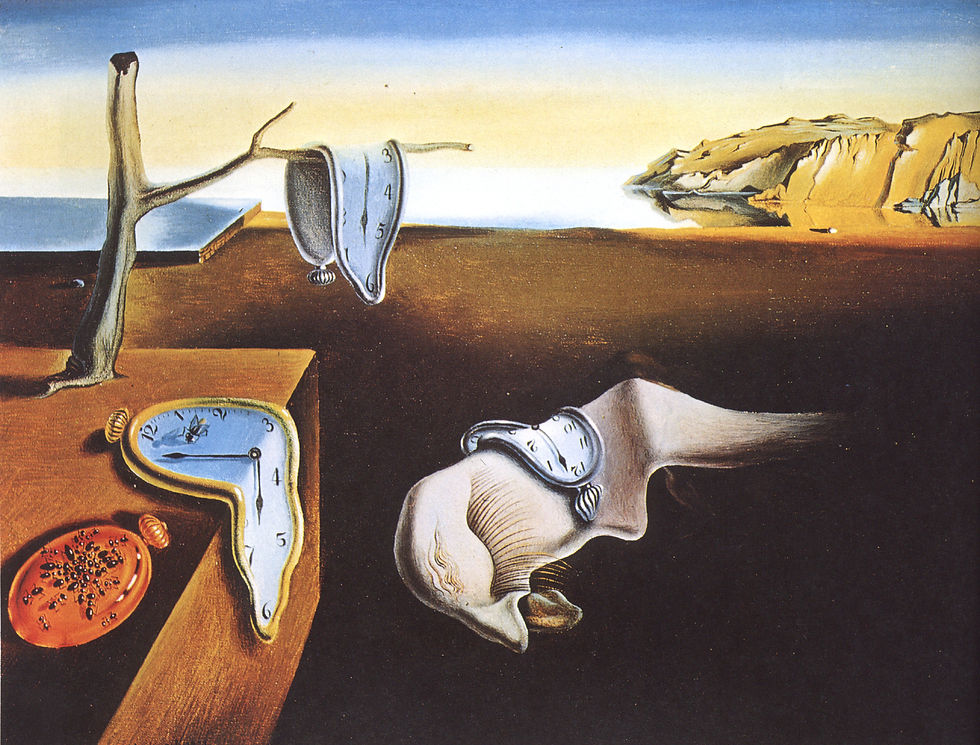
One of Dalí’s most well-known pieces of art is The Persistence of Memory. The
Persistence of Memory was created in 1931, using oil on canvas, and is 24.1x33cm, and was first exhibited at the Pierre Colle Gallery in June 1931. The piece can be found today at the Museum of Modern Art, in New York. The image is made up of dark muted colors, red, orange, blue, and black. On the left side of the painting is a bright orange square with yellow highlights, and then towards the right bottom corner everything fades into black. Up in the right-hand corner the black fades into a dark brown, and then the light orange color again in what looks to be mountains. Then the sky starts out as white and fades into a grayish blue color which adds an interesting contrast between the dark ground and the light sky. Although the image itself may look to be just like clocks melting, there is quite a bit of symbolism in the piece. Salvador Dalí himself wrote himself,
“It was on an evening when I felt tired, and had a slight headache, which is extremely rare with me. We were to go to a moving picture with some friends, and at the last moment I decided not to go. Gala would go with them, and I would stay home and go to bed early. We had topped off our meal with a strong Camembert, and after everybody had gone I remained along time at the table meditating on the philosophic problems of the ‘super-soft’ which the cheese presented to my mind. I got up and went into my studio, where I lit the light in order to cast a final glance, as is my habit, at the picture I was in the midst of painting. This picture represented a landscape near PortLligat, whose rocks were lighted by a transparent and melancholy twilight; in the foreground [was] an olive tree with its branches cut, and without leaves. I knew that the atmosphere which I had succeeded in creating with this landscape was to serve as a setting for some idea, for some surprising image, but I did not in the least know what it was going to be. I was about to turn out the light, when instantaneously I ‘saw’ the solution. I saw two soft watches, one of them hanging lamentably on the branches of the olive tree. In spite of the fact that my headache had increased to the point of becoming very painful, I avidly prepared my palette and set to work. When Gala returned from the theatre two hours later the picture, which was to become one of my most famous, was completed.”
Dalí is basically depicting a dream he had in the painting. Which he does so successfully because in dreams everything is very surreal, and hard to explain what things are. On the left side of the painting there are the iconic melting clocks symbolizing the non-linear, subjective time, there are three clocks meant to represent the past, present, and future.
In the middle of the image is a large white object which almost looks like a dead bird with
eyelashes. This is meant to represent Dalí in his dream. In his autobiography, Dalí writes,
“Dream is death, or at least an absence from the reality, or, even better, the death of reality itself, which is exactly the same dying during the act of love”. It is a testament to his insecurity. Gala only, he would say after the death of his wife, “knowing my helplessness, hid my hermit oyster flesh in a fortress-shell, and with that has saved me.”
Next to the largest melting clock in the left corner is a dark orange solid clock dial with tiny
black ants crawling all over it. The clock is symbolizing objective time, and the ants are meant to symbolize decay and decomposition. The ants also add more contrast and movement to the
picture. The next symbolism in the painting that is not as noticeable at first, is the fly on the
largest clock. Dalí referred to fly’s as “Mediterranean fairies” and in his “Diary of a Genius.”
Dalí writes,
“They brought inspiration to the Greek philosophers, who spent their lives under the sun,
plastered with flies.”
The fly also, like the ants, could be a symbolism for death. The tree is a symbolism for wisdom,
and the mountains are representing Cape Creus, which was on the Catalan Mediterranean coast near the town where Dalí was born. Dalí often would include this mountain in his artwork. The sea is meant to symbolize immortality and eternity, and back towards the mountains is a very small white egg. This egg is representing the idea of life. Dalí borrowed this concept from the Greek Mystics, Orphics. In the mythology of the Orphics, the shell of the egg formed heaven and earth. The blueish gray board by the tree, is actually a mirror. The mirror symbolizes impermanence, and changeability, reflecting the subjective and objective world. The piece is meant to act as a contradiction to what we know is real. Watches cannot be melting and warped or eaten by ants.
One painter that Dalí was heavily inspired by was the Dutch renaissance painter,
Hieronymus Bosch’ (c. 1450-1516) whom many surrealists believed to be the first “modern
artist”9 Dalí was inspired primarily by his piece titled “The Garden of Earthly Delights.” This
piece was a triptych, it was 220x390, and depicts three different settings from right to left,
Paradise, The Garden, and Hell. Very little is known about Bosch, but it is said that he often
used the themes of sin, death, and corruption in his artwork. “The Garden of Earthly Delights” is an extremely unsettling piece of art. On the left side, it depicts Adam and Eve, both naked,
standing next to a much taller figure, most likely God. Below them is what looks like a pond,
with different creatures crawling out of it. Some of the animals are shown killing each other,
therefore representing how corrupt the world becomes. Towards the top is a light pink structure
which is pointed upward, drawing your eye to more imaginative animals. The middle scene
depicted in the triptych, is much busier with hundreds of different figures. The colors, and
shadows are very similar to the first scene. The pastel color pallet creates a playful whimsical
feel to it. Looking closely at it however you can see just how strange and surreal it really is.
Figures are shown carrying large fruit such as strawberries. Other figures are almost tangled up together, or carrying large pieces of fish. This scene is meant to depict God’s creations
disobeying him. The final scene is much different than the previous two. The colors are much
darker, and there is much more contrast and shadows. This scene is depicting Hell, and it is easy to see why. The surreal art style Bosch used makes it seem even more horrific than other well known depictions of Hell, such as Giotto’s “The Last Judgment” (ca. 1307). Or Pieter Bruegel the Elder’s “Dulle Griet” (1561). Both of those paintings are much more realistic whereas Bosch choses to use imaginative almost childlike figures to make you think the image is innocent, but when you look closer it is very gruesome and gory. This is a recurring theme throughout Bosch’s creations
“References to astrology, folklore, witchcraft, and alchemy, in addition to the theme of the
Antichrist and episodes from the lives of exemplary saints, are all woven together by Bosch into
a labyrinth of late medieval Christian iconography.”
It is clear to see that both Bosch, and Dalí were great masters at creating a sublime aesthetic
However, their art has more in common than just stylistic similarities. Dalí actually was heavily influenced by Bosch’s paintings and techniques. Many people even thing that Dalí may have recreated a rock formation face that Bosch had originally painted in his “Garden of Earthly Delights”, in his piece titled “The Great Masturbator.” Both Dalí and Bosch also used religious themes in their artwork. Another interesting comparison between Bosch and Dalí is that both use birds in their artwork. Dalí uses a sleeping bird to represent himself in “The Persistence of Memory.”, and Bosch has some sort of bird, or flying animal in almost all his art works. Birds can often symbolize Christianity in art, referencing how the Holy Spirit is often depicted as a dove. But they also can be used to symbolize immortality which is an interesting concept that maybe Bosch and Dalí were trying to convey with their artworks. Dalí’s “The Persistence of Memory.” Symbolizes how time does not exist in a dream, and so in some ways you live on forever when you are dreaming. Bosch’s “The Garden of Earthly Delights.” Depicts the creation of the universe, and the consequences of disobedience will be suffering for eternity in Hell.
To this day Dalí is still just as relevant, and you can see it in so many ways in our culture.
You can go into stores and find t shirts and socks with his art on them. Dalí also worked on
different films and plays. Dalí created the scenery for Fedrico García Lorca’s play “Mariana
Pineda” (1927), and for “Bacchanale” (1939) which was a ballet based on Richard Wagner’s
opera, “Tannhäuser.” He is also credited as co-creator of the surrealist film “Un Chien Andalou”and worked Alfred Hitchcock to create a dream sequence in Hitchcock’s “Spellbound.” Dalí even worked with Walt Disney to create a short film titled “Destino.” Although they were never able to finish it themselves due to financial complications, the film was completed in 2003 and shown in various film festivals. Dalí has been portrayed in films by Robert Pattinson in “Little Ashes.” (2008), and Adrien Brody in “Midnight in Paris.” (2011). He was even portrayed in a Sesame Street Skit as a Muppet called “Salvador Dada.”
It is clear to see that people from all over the world have taken inspiration from Dalí’s art
and his unique way of creating it. And that is why I believe he is the greatest and most influential surrealists of all time. He was able to create things no one had ever seen before in art, and yet still find a way to make the viewer relate to his creations. And although he was nowhere near perfect, I think that also helps people to understand just how much his artwork represented his emotions.
Sources:
Basquin, Kit. "Salvador Dali: images of the surreal." School Arts 91.8 (1992): 33+. Business
Insights: Global. Web. 3 Sept.
2021.
Beams, Sophia. “The Story BEHIND Salvador Dali's ‘The Persistence of Memory.’” Medium.
Everything Art, August 7, 2020. https://medium.com/everything-art/the-story-behind-salvadordalis-
the-persistence-of-memory-acb11f1766a6.
“Bosch, Hieronymus.” 2018. Funk & Wagnalls New World Encyclopedia, January, 1;
Brown, Jack Perry. “The Land of Unlikeness: Hieronymous Bosch, The Garden of Earthly
Delights.” Library Journal137, no. 11 (June 15, 2012): 76.
Cardona, Rodolfo, and David Carter. “Salvador Dali.” Salvador Dali, Jan. 1995, pp. 7–34.
Charles, Victoria. 2011. Dalí. New York: Parkstone International.
Editorial, Artsy, and Alexxa Gotthardt. “Hieronymous Bosch's ‘Garden of Earthly Delights.’”
Artsy, October 18, 2019. https://www.artsy.net/article/artsy-editorial-decoding-boschs-wildwhimsical-
garden-earthly-delights.
Editorial, Artsy, and Sarah Dotson. “Salvador Dalí's ‘The Persistence of Memory.’” Artsy,
August 4, 2020. https://www.artsy.net/series/stories-10-art-historys-iconic-works/artsy-editorialunderstanding-
the-persistence-memory-salvador-dalis-surrealist-masterpiece.
Falkenburg, Reindert L. “Black Holes in Bosch: Visual Typology in the Garden of Earthly
Delights.” In Image and Imagination of the Religious Self in Late Medieval and Early Modern
Europe, 105–31. Turnhout, Belgium, 2007.
https://search.ebscohost.com/login.aspx?direct=true&db=rfh&AN=ATLA0001694165&site=eho
st-live.
Francie Cate-Arries, and Francie Cate-Arries. “Salvador Dalí, Federico García Lorca, and the
Persistence of Memory: Revealing Hidden Faces.” Anales de La Literatura Española
Contemporánea, vol. 20, no. 1/2, Jan. 1995, pp. 11–28. EBSCOhost,
Harmon, Melissa Burdick. 2001. “The Mad, Magnificent Salvador Dali.” Biography 5 (1): 106.
Kandaurova, Natalya. “Bosch and the Surrealists: Your Guide to Wild Imagination.” Arthive,
January 28, 2020.
“The Persistence of Memory Hidden Symbols.” Art Kaleidoscope, April 26, 2019.
“Persistence of MEMORY, 1931 by Salvador Dali.” 10 Secrets of "The Persistence of Memory"
by Salvador Dali. Accessed September 9, 2021. https://www.dalipaintings.com/persistence-ofmemory.
jsp.
Phaidon. “Salvador Dali's the Persistence of Memory Explained.” Phaidon. Accessed September
9, 2021. https://www.phaidon.com/agenda/art/articles/2016/may/10/salvador-dalis-thepersistence-
of-memory-explained/.
Pitts Rembert, Virginia. 2012. Bosch. Temporis. New York: Parkstone International.
“Salvador Dalí Biography, Life & QUOTES.” The Art Story. Accessed September 9, 2021.
“Salvador Dalí.” Encyclopædia Britannica. Encyclopædia Britannica, inc. Accessed September
“Salvador Dali.” Hieronymus Bosch The Sublime Before its Time. Accessed September 9, 2021.
“Salvador Dalí.” Salvador Dalí Museum, December 15, 2020. https://thedali.org/about-themuseum/
timeline/.
“Salvador Dalí.” Ultimate Pop Culture Wiki. Accessed October 6, 2021.
Shanes, Eric. 2010. The Life and Masterworks of Salvador Dalí. Temporis. New York: Parkstone
International.
Vodopyanova, Anna. “Influence, Rivalry and Obsession: Dalí and Picasso.” The Gabber
Newspaper, December 18, 2014. https://thegabber.com/influence-rivalry-and-obsession-dali-andpicasso/.
Wolfthal, Diane. 2020. “Hieronymus Bosch.” Salem Press Biographical Encyclopedia.
https://search.ebscohost.com/login.aspx?direct=true&db=ers&AN=88367461.


Comments